

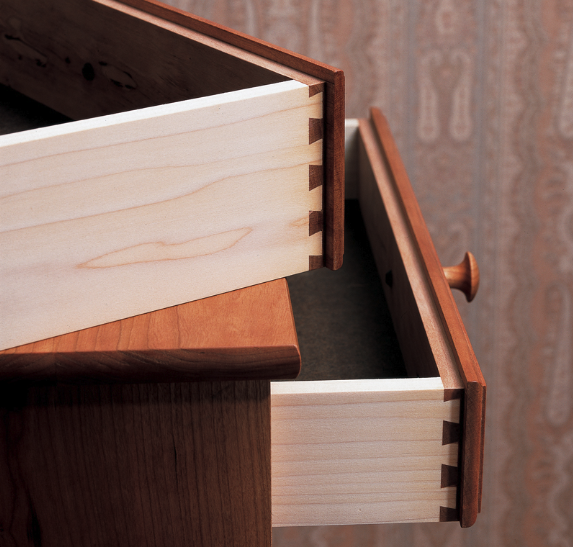
As one of Indigo’s meticulous engineers, I’ve had the privilege of studying and examining various construction techniques employed in the industry. There are many methods used to construct drawer boxes, butt, dado, and dowel joints just to name a few, but among them, there’s one in particular that stand out, dovetails. You’re probably asking yourself why you should care about this. Well, let’s jump in, and I’ll share that with you.
Drawer Box Construction
Let’s talk basics first. You may be thinking, so what, it’s just a wooden box. Well, the method of joinery used to connect each piece plays a crucial role in determining the drawer’s strength, stability, and overall longevity. And there’s no match to the precision and durability of dovetails joints.
The Dovetail Advantage
The interlocking pattern of a dovetail joint is not only visually appealing (look for yourself if you don’t believe me) but also highly functional. The joint consists of trapezoidal pins and tails that fit together snugly, creating a self-locking bond. This mechanical interlocking ensures that the joints stay tight, even under significant stress or constant use.
Superior Strength & Durability
When it comes to strength and durability, dovetails are unrivaled. The interlocking design distributes stress evenly across the joint, preventing the drawer box from warping, pulling apart, or collapsing. Those trapezoidal pins I was telling you about work harmoniously with the tails increasing the glue surface area, therefore enhancing the adhesive strength, and creating a bond that can withstand heavy loads and repeated opening and closing.
Triple Threat
The beauty of dovetail joints extends beyond its strength and reliability, which make them less likely to develop problems like loose joints, sticking drawers, or weakened structural integrity. They also possess an elegant, handcrafted aesthetic that adds a touch of sophistication, becoming a quite the focal point of admiration.
Craftsmanship & Prestige
Requiring precision and skill to create, crafting dovetails by hand is a time-consuming process that demands expertise and patience. As a result, furniture featuring dovetail joints are often associated with quality, prestige, and superior workmanship.
When it comes to drawer box construction, dovetail joints stand as the pinnacle of excellence. They provide unmatched strength, durability, and resistance to wear and tear, and they also radiate timeless beauty and prestige. While other joint methods may suffice for less demanding applications, dovetails remain the gold standard for those who seek craftsmanship, quality, and furniture that will last a lifetime. So, the next time you come across a piece of furniture with dovetail joints, take a moment to appreciate the artistry and dedication behind its construction.
Leave a Reply